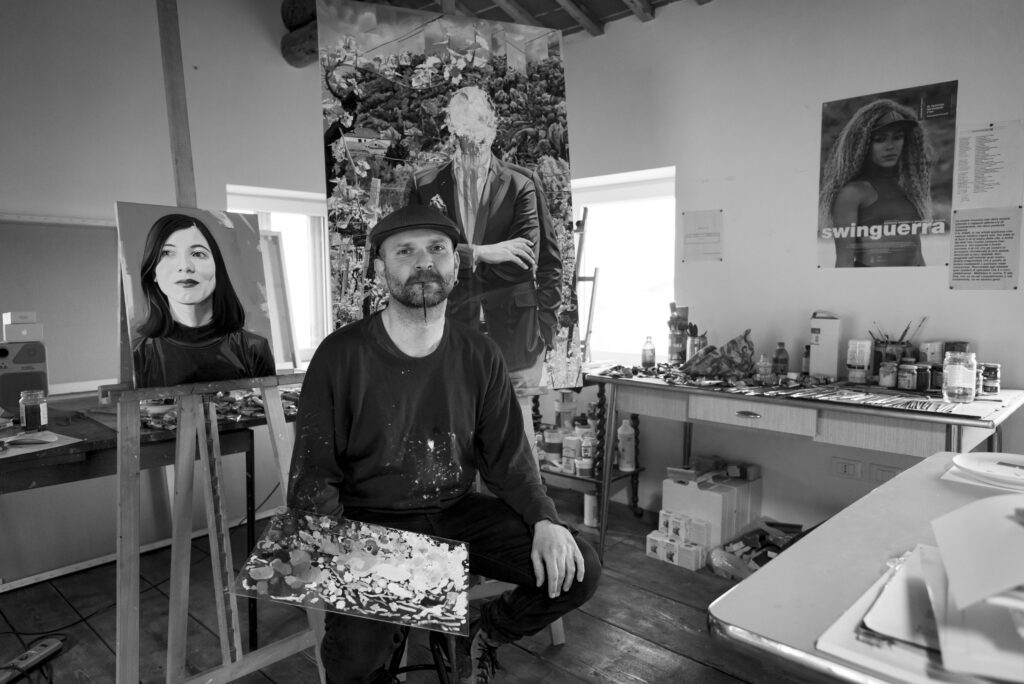
Manuel Pablo Pace is a painter based in Italy. He trained at the Academy of Fine Arts in Venice and has exhibited internationally, including at Scope New York, Art Verona, and Parallax London.
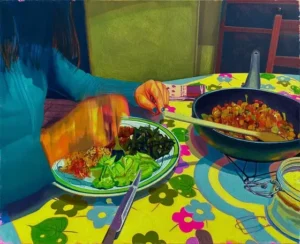
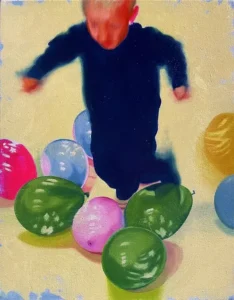
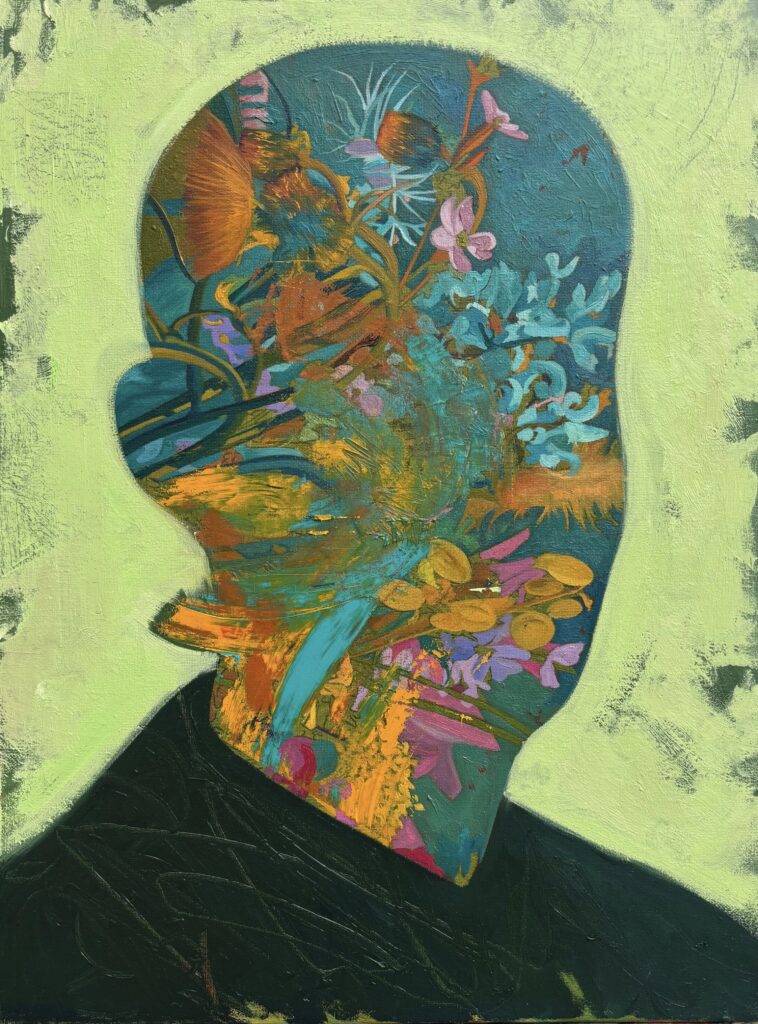
He doesn’t paint to describe what he sees, but to test where an image begins to fail.
He starts from familiar situations and moves against them.
Faces refuse to settle, presence slips, and what feels intimate turns slightly off. Colour doesn’t describe reality — it works against it.
These paintings stay where the image is already failing. They don’t try to resolve.
____________________
How would you describe your work to someone discovering it for the first time?
For years, I tried to remain faithful to what I saw.
Today, I’m interested in how far I can betray it without losing everything.
Photography has been a structure, but also a limit.
Now I use it as a starting point to let the image collapse.
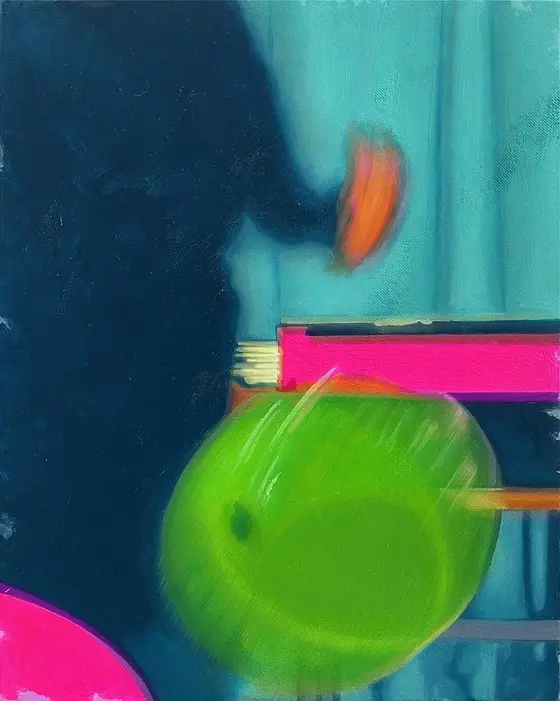
I begin with recognizable situations — often close, everyday — and push them into an unstable zone, where perception is no longer fully reliable.
There is always a threshold: something that seems still, but is already shifting.
At the core of this process is a precise tension: the attempt to hold onto something I already know will slip away — faces, presences, what remains when we can no longer fix them.
You trained at the Academy of Fine Arts in Venice, an institution with a very strong tradition of portraiture and the human figure.
How did that training shape — or complicate — your relationship with the face?
I was trained in a context where figurative painting was considered outdated.
The face, in particular, was seen as regressive. Those who focused on it were often reduced to something merely decorative.
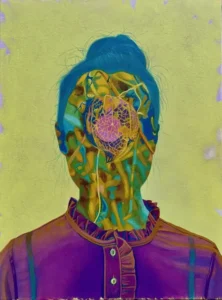
I came from a hybrid language, between figuration and graffiti, and that placed me outside both directions. The face emerges from that friction. I’m not interested in it as something to resolve, but as a site where different visual systems collide: classical painting, comics, advertising.
I don’t see them as hierarchical. I see them as unstable.
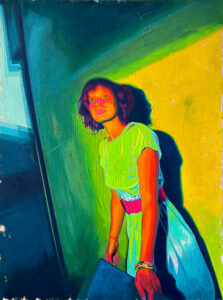
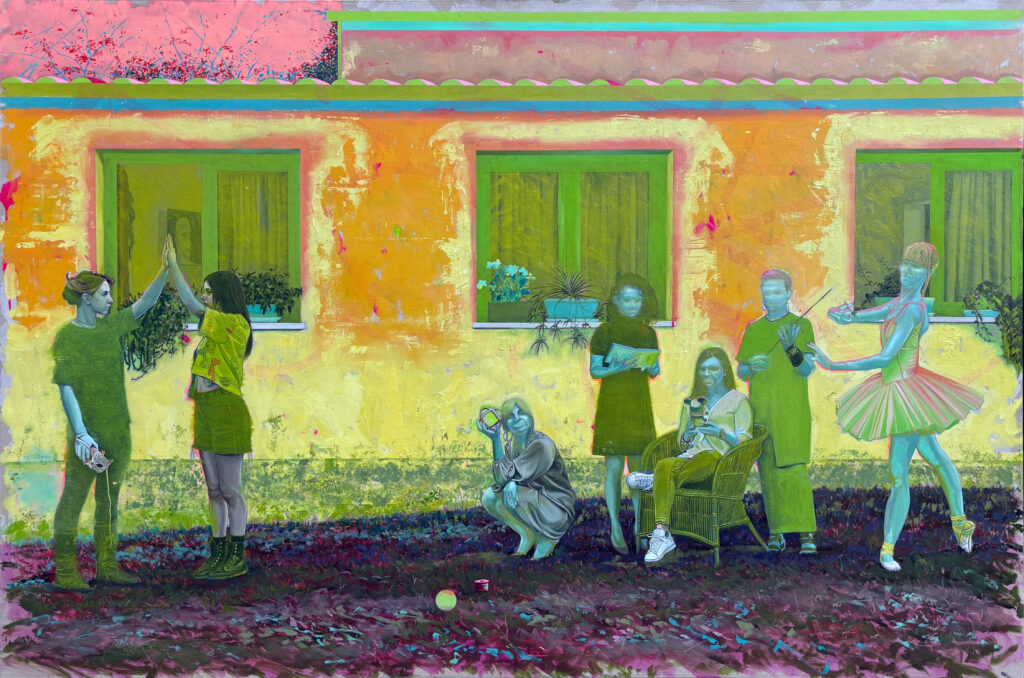
This tension is also visible in works like The Yellow Facade, where the image oscillates between recognition and instability.
You speak of two registers in your practice: commissioned hyperrealist works on one side, and a personal research that deconstructs representation on the other.
How do they coexist in your studio on a day-to-day basis?
Commissions are where painting encounters real resistance.
The subject usually arrives with a constructed image of themselves, often highly controlled.
My work enters that space and puts it under pressure.
I’m not interested in confirming that image. I’m interested in how much it can hold.
This tension has given me the tools to construct with precision, but also the awareness needed to push the image beyond that threshold in my personal work.
Without that discipline, freedom would be arbitrary. With it, it can become rupture.
In your statement, you write that colour is an “emotional fact rather than optical truth.”
Could you give me an example — a specific work, a colour decision — where that played out for you?
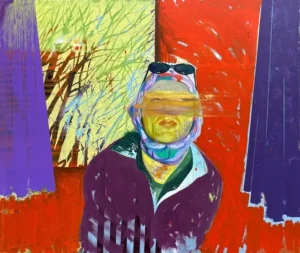
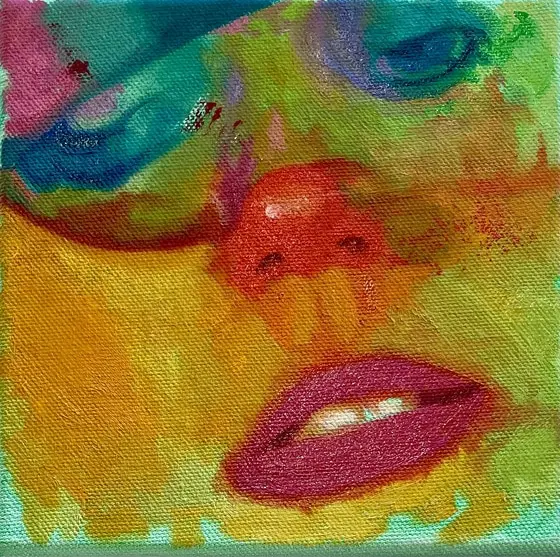
Colour is never neutral. It is a deviation.
It comes from observation pushed to the point where it stops being objective.
When I look at something long enough, reality begins to lose coherence.
In The Aquarium, for example, colour no longer follows a plausible light source.
It builds a perceptual condition instead — something slightly off, almost suspended.
The light I’m searching for does not exist. It doesn’t describe a space — it destabilizes it.
Colour is not there to clarify. It is there to shift perception.
Some of your titles feel almost like fragments of thought: What if I had been, That Day Without an Audience.
Where do they come from? Does the title arrive before or after the work?
Titles don’t explain the work. They arrive after something has already happened, or sometimes before, as a trigger.
I think of them as traces, not definitions.
They shouldn’t close the image. They should keep it open.
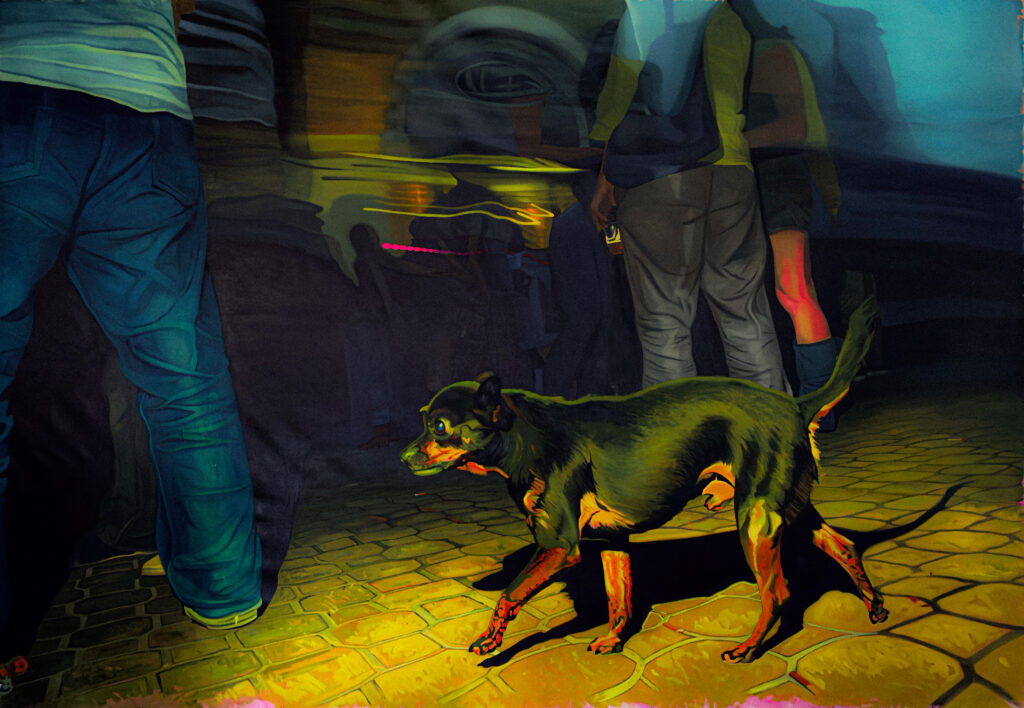
Some of your pieces are very large-scale — That Day Without an Audience (one of my personal favourites) being a striking example.
Does the subject determine the size of the canvas?
Scale comes from an internal necessity within the image.
In That Day Without an Audience, the large format amplifies a sense of distance and isolation.
The viewer is drawn into the space, but at the same time kept at a distance.
Some images, if kept small, resolve too easily.
At a larger scale, they become harder to control — even for me.
Pressure increases. And with it, risk. That’s where the work becomes necessary.
What remains, in your view, when you strip likeness from a portrait?
When I remove likeness, I lose a reference point. I’m no longer trying to represent someone, nor to preserve them.
I’m working on what remains when an image can no longer be fixed.
It’s an unstable condition: there is no external criterion holding the image together.
If it works, it’s not because it’s correct. It’s because, despite everything, it holds.
Do you have any upcoming projects or exhibitions you’re particularly excited about?
At the moment, I’m working on pushing this process further.
I’m interested in reaching a point where the image doesn’t simply get looked at, but actively alters the viewer’s perception.
Painting remains the core. Everything else — exhibitions, contexts, international expansion — has to follow from that, not the other way around.