
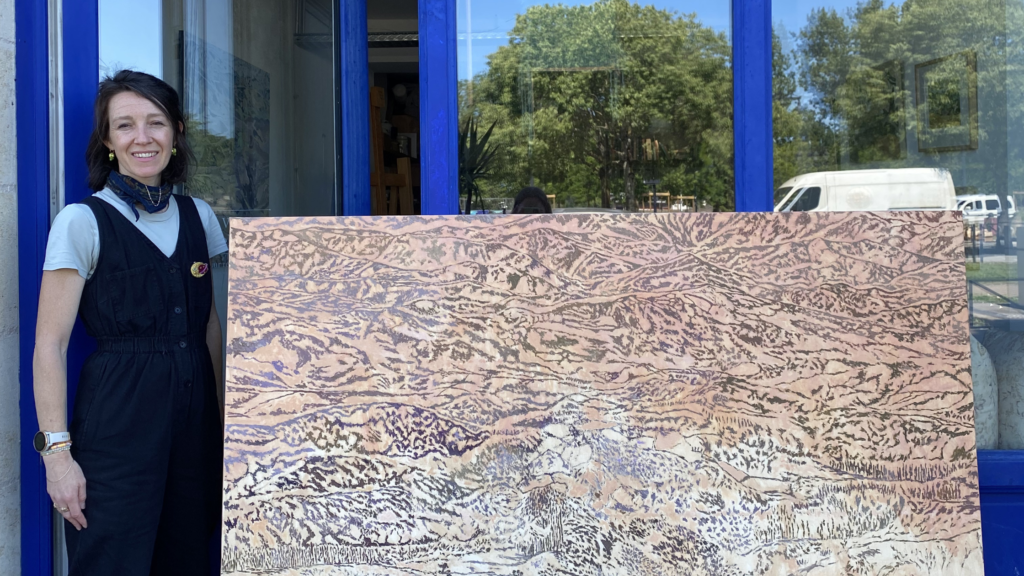
Katy Wright is a British painter based in Bordeaux, France, where she has lived for several years. She holds a Master’s degree in Fine Art from Falmouth University.
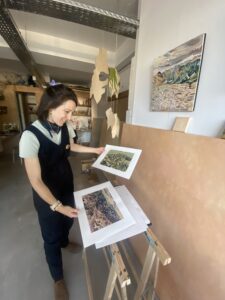
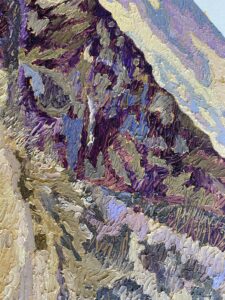
Working primarily in oil paint, she develops a visual language through which she interprets and interacts with the landscape, both urban and natural. Applied directly with a palette knife, her paint is mixed by hand, making the material process itself an intrinsic part of the work.
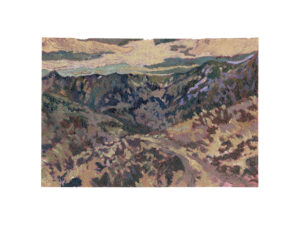
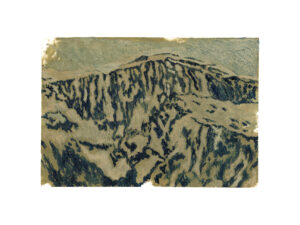
Her paintings move between the rooftops of Bordeaux and the mountains she approaches as spiritual and political terrain, a symbol of resilience in the face of the Anthropocene. Built from complex secondary hues that evoke natural tones, her canvases carry multiple bodies at once: composition, memory, and pattern. Her work invites a sense of humility before the vast landscape, reminding us that everything is connected.
If you had to summarize your work in one sentence, what would it be?
My practice consists of a visual language through which I interact with and interpret the landscape.
What led you to painting rather than another medium?
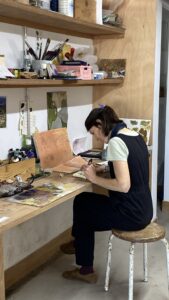
The texture and materiality of oil paint perfectly respond to the need to “feel” the preparation and mixing of colors. The ritual and intuitive dimension of mixing are also an integral part of the process. It contributes to creating layers of information that are not directly visible in the final work. Production always begins with a drawing, often quite detailed, which establishes the composition. I then wanted to find a medium that would complement, but also contrast with, the line and traces of pencil. That is how I chose oil paint. I mix it and apply it directly with a palette knife. This preparation is part of the process, it is important for me to feel that I am making the material with my hands.
Your urban paintings and landscapes seem to inhabit two different territories — is there a thread that connects them for you?
Yes, several things connect them. First, the material itself. Through these two subjects, and even in future works, there is always a fascination; almost an obsession; with matter, which I feel immersed in. The second is the search for composition. I like finding a composition that can be several things at once: the landscape, the memory of a place, but also a kind of pattern or motif. Each painting therefore has multiple bodies.
Finally, there is a need to gain distance, to seek the summit, but also a desire to step back and see the bigger picture. We have become increasingly obsessed with the individual, wanting everything immediately, constantly feeding the “self.” Through my paintings, I would like to express a sense of humility in the face of the vast landscape, and to remind us that everything is connected.
Was this shift toward the natural landscape a deliberate rupture, or something that imposed itself naturally?
A bit of both. Between 2022 and 2024, I completed a Master’s degree in Fine Art at Falmouth University in England. After several years of painting only the rooftops of Bordeaux, I felt the need to search for my true convictions and to conceptualize my practice. Sustainability emerged as a political concern. The mountain therefore became a concrete decision, using it as a symbol and metaphor for overcoming difficulties, such as living in the Anthropocene. For me, the mountain is also a spiritual place, where I become a pilgrim searching for something, or simply for myself. That said, I now feel that these reflections and conceptual foundations also restore meaning to the rooftops. Unconsciously, there was already significance there. I would love to exhibit the mountains and rooftops together, because I think a very interesting dialogue could emerge from it.
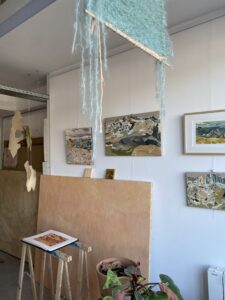
Do you paint from life, from memory, or from photographs? Does it change what you are trying to capture?
I want to answer: all three! How is that possible? I often work from a photograph I have taken myself, which allows me to interpret a structure.
Drawing brings me back to childhood; it is a very important language for me. I first draw the structure, then I lose myself in the painting, in a moment of movement and sensation. I think everything contains both structure and surrender. That is what creates balance, and in my personal life, I also try to find that balance between the two.
Photography also allows me to access memory, which becomes more active while painting, that is the moment of surrender. During the process, I no longer see the photograph as anything more than a series of shapes and patterns.
One could observe a process of deconstruction and reconstruction: a way of understanding, creating something new, and also repairing. Rupture and healing.
How would you describe your color palette?
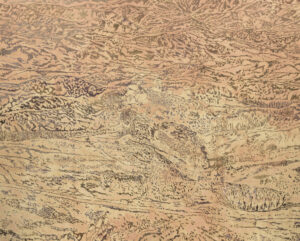
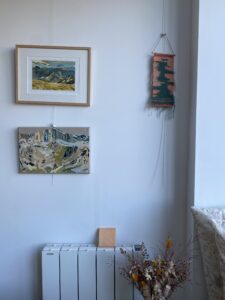
Mixing colors is, for me, the moment of surrender. My colors are quite complex to create, built from many shades, a bit like creating a dish from numerous ingredients. I am sensitive to these complex tones, much like the vibrations of violin or guitar strings: they communicate on several levels. One could observe that the colors I use tend toward secondary colors; greens, oranges, purples; which are by nature more complex, as they are made from at least two primary colors.
Is there a color you cannot seem to leave behind, or conversely one you avoid?
To follow on from what I just said, I would say that it is rare for me to use a color straight from the tube without transforming it. The colors I create often resemble natural tones. I collect small stones in the mountains and keep them in my pockets because of their colors.
Has there been an interpretation of your work by someone else that surprised you?
I was pleasantly surprised recently by someone who perceived links to the human body in my work. I have always questioned our place on Earth, and I am deeply concerned about the current state of our planet. Recently, my works have resembled skin: the colors of my mountains reflect human flesh, and conversely, my urban landscapes can contain echoes of mountains in the tones I give them. It is my way of showing that everything is connected, and of decentering the importance of the human being.
Do you have any exhibitions or projects coming up this year?
I have several opportunities to exhibit my work this year, and I am currently preparing as many works as possible. I will also participate in group exhibitions in order to bring ideas together and open further dialogues.
Are you currently working on a particular series?
At the moment, I am passionate about the dichotomies between the urban environment and the landscape. For the past two years, my works have been more focused on mountains. Recently, I have once again felt the desire to draw Bordeaux, and I would love to exhibit both together, so that the rooftops and mountains can “speak” to one another within a gallery space. At the same time, clouds have been drawing a lot of my attention lately. It would be interesting to change elements and look toward the sky.
Follow Katy Wright on Instagram to keep up to date with her latest news and discover more of her work!