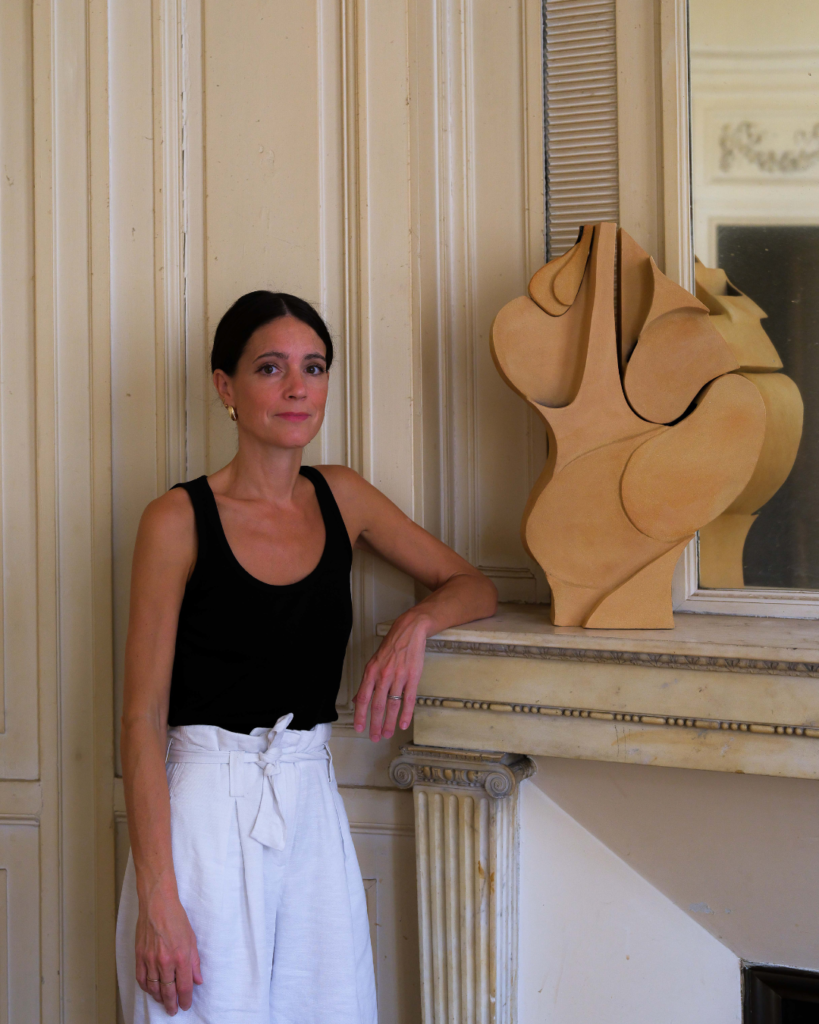
Architect – urban planner for 15 years and a graduate of the École Nationale Supérieure d’Architecture de Paris-Belleville, Caroline Desile naturally moved toward an artistic practice guided by her passion for Land Art, modern and brutalist architecture, and landscapes shaped by time.
Ceramics provide the artist with a means to explore and express the relationship between Humanity, Architecture, and Nature.
Each piece becomes a fragment of territory, a microcosm in which matter, light, and space converge to evoke the living world.
____________________
How would you describe your work to someone encountering it for the first time ?
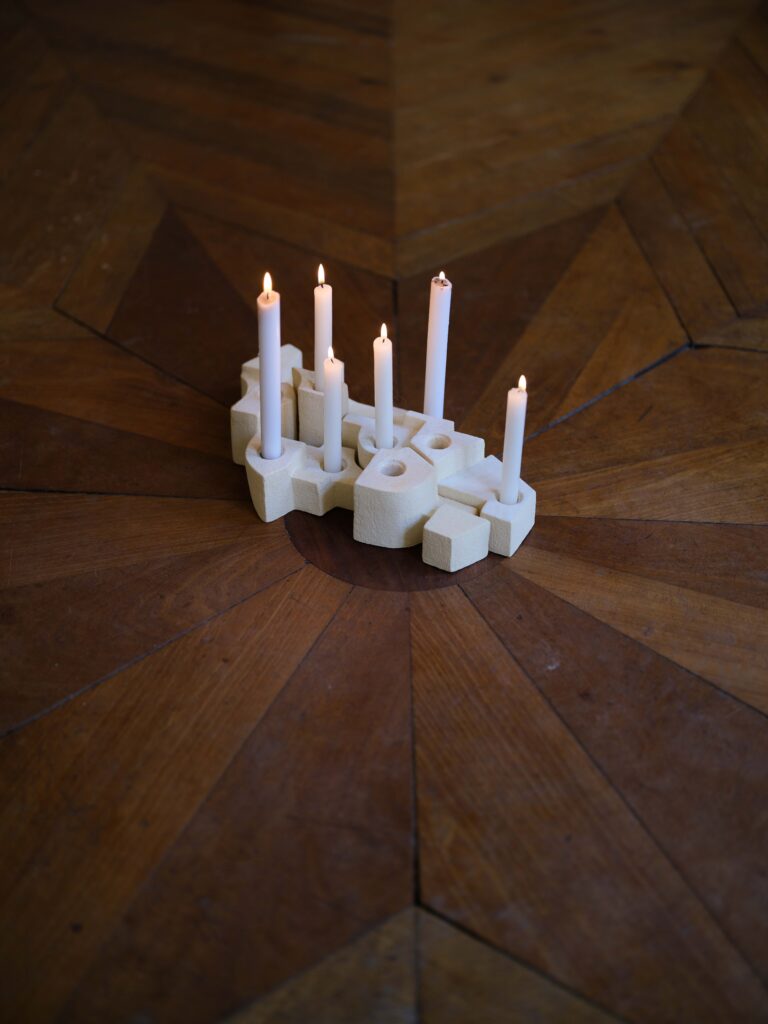
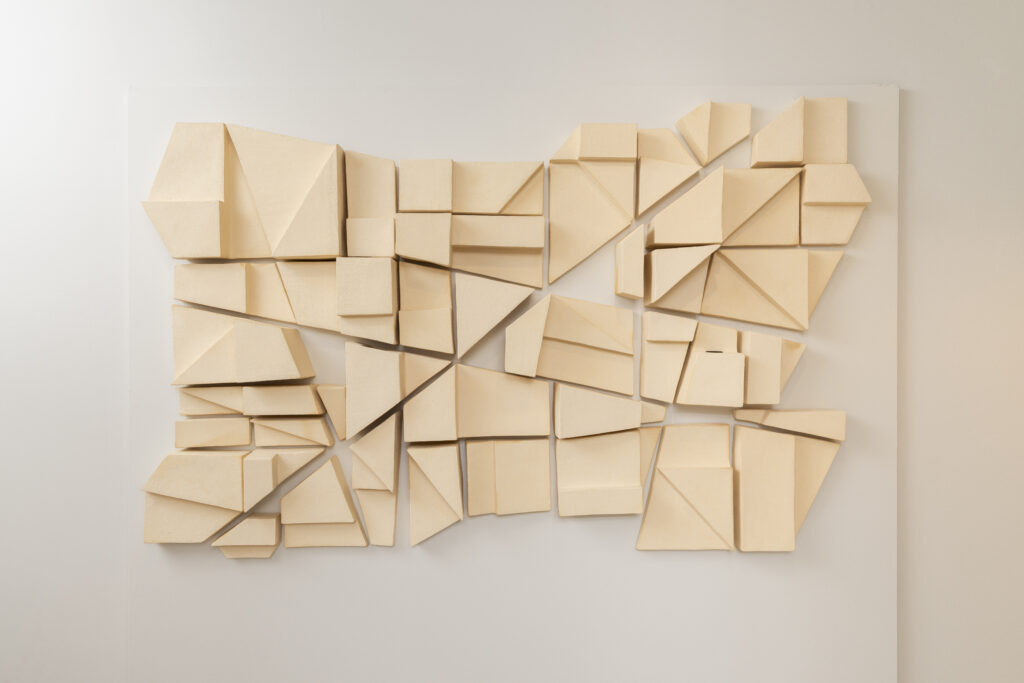
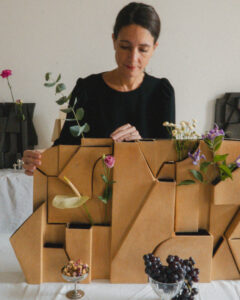
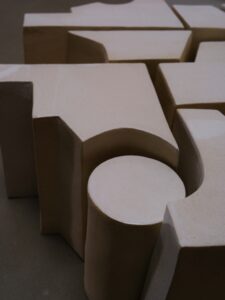
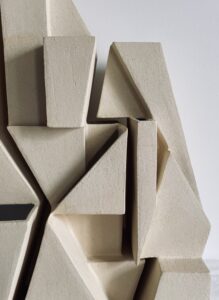
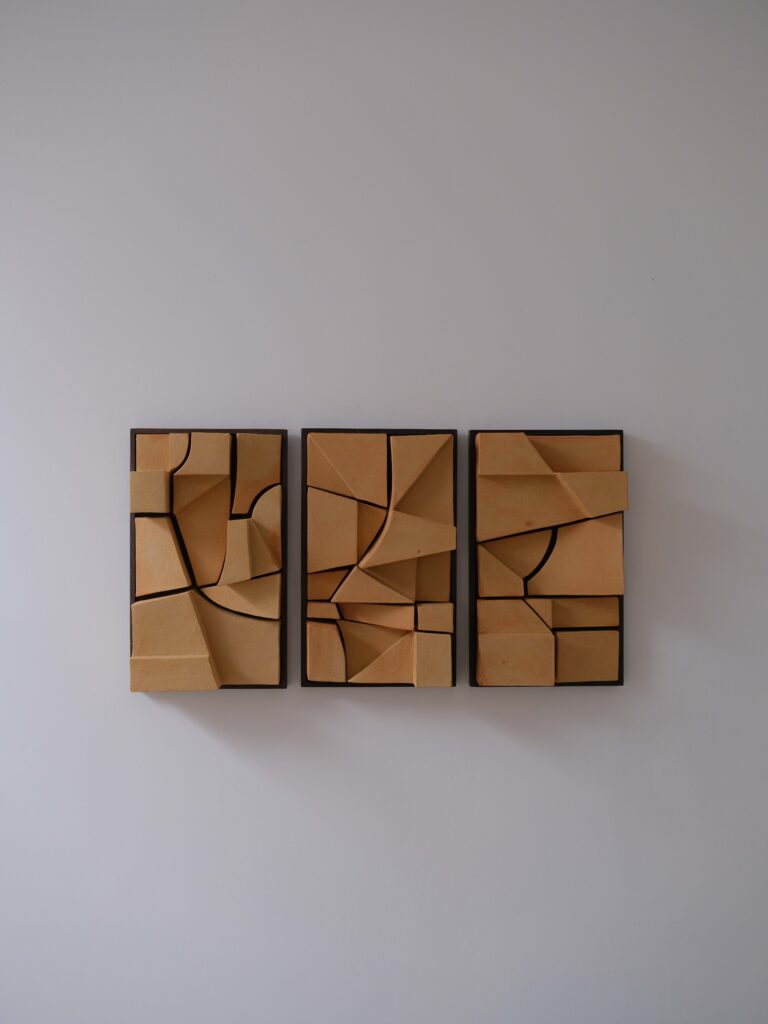
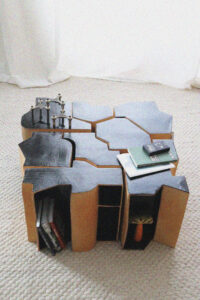
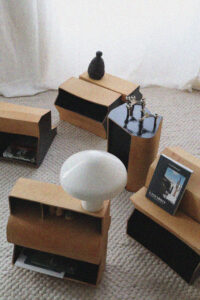
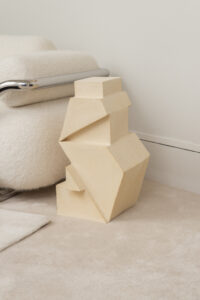
I create modular stoneware sculptures conceived as stratified micro-architectures, evoking utopian territories or imaginary remnants.
You have a background in architecture and urban planning and worked for several years in that field before fully dedicating yourself to ceramics.
How does your architectural training influence the way you think about and create your pieces ?
My training as an architect and urban planner deeply shapes my perception of our environment and fuels my inspirations.
I am fascinated by Land Art, architecture, particularly modern and brutalist architecture, as well as landscapes shaped by time : reliefs, strata, erosion. Through material, I discovered a new field of exploration that continues my previous path, both tangible and symbolic. Working with modularity allows me to conceive each piece as a fragment of territory, a reinterpretation of our world, whether built or organic, in constant transformation.
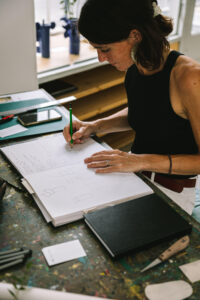
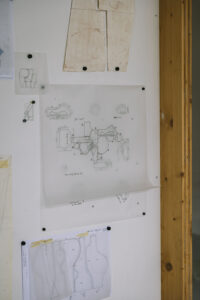
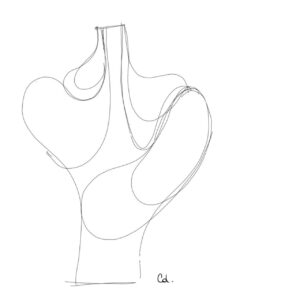
My background also influences my creative process. Starting from a word or an intuition, I produce a sketch, followed by a stage of geometrization: translating the idea into a plan through the creation of a template. This step, inherited from architecture, prepares the shaping and construction phase of these micro-architectures.
Do you work with specific intentions, or do you allow the material to surprise you during the creative process ?
There is always a balance of both in my work. The sketches are part of an overall reflection and always follow an intuition, sometimes striking, sometimes fleeting, that is not necessarily “controlled” but rather emerges from my various sources of inspiration.
Once I am convinced by a sketch, its “technical” drawing enters a precise stage of pattern-making. But as soon as my hands touch the clay, a new balance emerges : initially guided by the templates, my hands gradually free themselves to allow more spontaneous volumes to develop, giving space to the material’s expressiveness through gesture.
Your works evoke relationships between humans, the city, and nature. How do these connections manifest in your creations ?
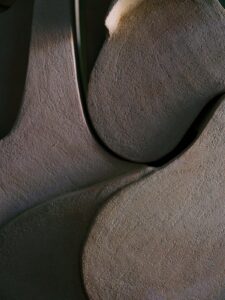
My work unfolds through architectural or organic forms, conceived as autonomous entities yet open to assembly and recomposition, much like the dynamics that structure cities and landscapes. They may evoke urban territories, utopian cities, or remnants, as well as natural reliefs shaped by erosion, or, depending on the viewer’s perspective, anthropomorphic forms.
Architecture appears as a new terrestrial layer, a trace left by the Anthropocene era on the ground and within the material itself. Gesture and the raw expressiveness of the medium make this human presence within the landscape visible. It is within this tension between construction and erosion, culture and nature, that the connection between humanity, the city, and territory is woven.
Many of your pieces play with the contrast between solid and void, and with architectural lines unfolding in space. Your work seems to invite the eye to explore space, do you see this as offering an immersive or a more contemplative experience ?
Void, whether the hollows within the pieces or the spacing between modules, plays a role just as important as the constructed matter. Much like the space between buildings defines public space as a site of encounter and social interaction, void here becomes a space of dialogue, an interface with the viewer, who can intervene in the composition.
Through this interplay of solid and void, the work becomes appropriable and a territory for exploration. These interstices, along with the material’s textures, turn into meeting points between shadow and light, revealing a shifting temporality and inviting an experience that is both immersive and contemplative.
Do you see your pieces more as objects, landscapes, or installations ?
I imagine my pieces as fragments of territory : modular sculptures in which the viewer’s visual and physical interaction fully participates in their perception.
Each element is autonomous, yet their association composes a broader landscape made of shadows and light, folds and reliefs. Some projects thus take the form of installations, reconstructing an imaginary territory through which one is invited to move and interact with the works.
Light plays a fundamental role here : it inscribes time and space onto the works, reveals reliefs, animates surfaces, and transforms the perception of the sculptures throughout the day. Through these plays of shadow, each piece becomes part of a shifting temporality, making space an active component of the sculpture.
How has your perception of your own work evolved from your first exhibition to today ?
At the beginning, although notions of relief, modularity, assembly, and materiality were already present, my work remained closely tied to function and the perception of the object.
Gradually, I realized that my primary aim was to develop a broader reflection on our relationship to what surrounds us, environment, light, and material, through a form of constructive play.
Writing about my practice also helped clarify the links between my architectural background and my sculptural work. Today, this research increasingly focuses on the question of human traces and our inscription within the landscape.
How do you situate ceramics today, between art, craft, and design, in light of the growing interest from collectors ?
Ceramics originate in craftsmanship, yet they open onto an immense field of experimentation that has always allowed its boundaries to be pushed.
Today, ceramics occupy an increasingly visible place within contemporary art and indeed attract growing interest from collectors.
What fascinates me is precisely this permeability between know-how, formal research, and conceptual reflection. Ceramics carry a history, a memory of gesture and material, enabling them to generate sensory experiences on par with any other medium.
Are there directions you have not yet explored but that attract you ?
Any form of experimentation, whether solely related to stoneware or combined with other materials such as wood, stone, or metal.
I am also drawn to further developing research and installations connected to my reflections on architecture, geology, light, and material.
Do you have any upcoming projects or exhibitions that particularly excite you for 2026 ?
I am currently taking part in a group exhibition until mid-April, Corps Terre Fibres, at Galerie Scène Ouverte in Paris, alongside several ongoing projects.
Some pieces will also be presented in the future MADD boutique in Bordeaux upon its reopening.
And I hope that additional projects will come together throughout 2026.