
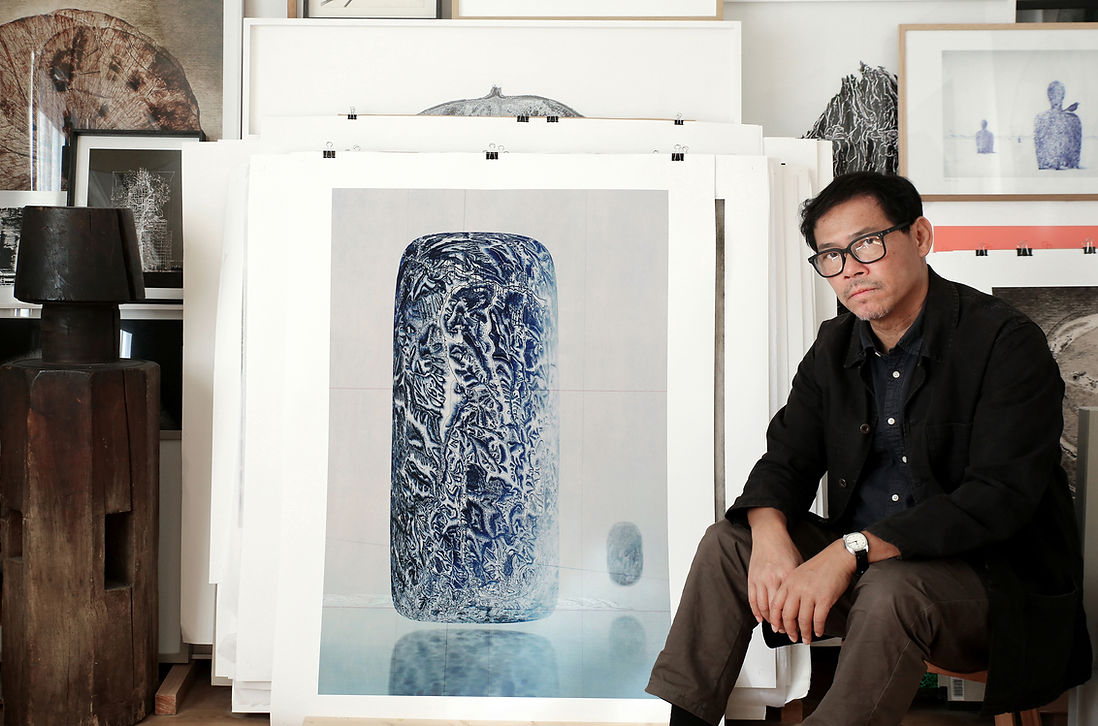
Sovann Kim explores our environment with a quiet sense of poetry. Using ordinary elements (plants, food, minerals) he reveals, through digital processes, the hidden beauty of their structures and textures, like a language or an architectural code. This approach gives rise to a subtle dialogue around metamorphosis and the decomposition of forms.
His work has been presented at several major international contemporary art events, including Art Basel, FIAC in Paris, and ARCO in Madrid. His artworks have been represented by Galerie Catherine Putman in Paris. He has also exhibited in prestigious institutions such as the Musée des Beaux-Arts in Nancy and the Triennale di Biella in Italy. His works are now part of numerous public and private collections, including the art libraries of Caen, La Rochelle, Amiens, La Roche-sur-Yon, Hennebont, as well as the AXA Art Collection.
Your work is based on ordinary elements (plants, food, minerals) that you transform through digital writing.
What draws you to these everyday materials ?
It’s precisely this notion of the “ordinary” that interests me, those small things we tend not to pay much attention to. I feel the need to pause regularly and look at them more closely, everything slows down, it’s like stopping time.
These elements possess such structural complexity when observed with the right tools, they are true architectures, with highly evolved frameworks and walls of great delicacy, like micro-buildings. They can spark a deep sense of imagination.
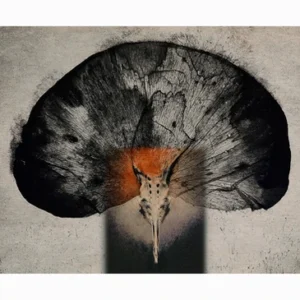
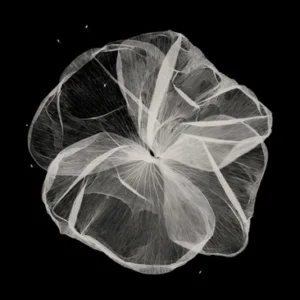
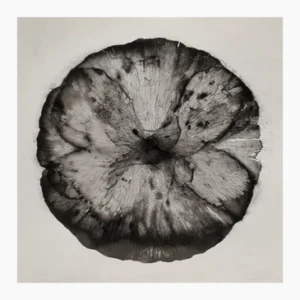
Fleur animale, édition, 70x90cm / Quais de Brumes, édition, 105x105cm / Disparition jour 16, édition, 105x105cm
Your works often sit at the border between abstraction and figuration. How do you navigate the path between what is identifiable and what remains more mysterious ?
That border is indeed what seems most characteristic of my work.
On the one hand, it’s not immediately clear whether you’re looking at a photograph or a painting, an engraving or a drawing, probably because I’m attached to the idea of breaking down the boundaries between different artistic disciplines and their modes of expression. I find that enriching.
Then, the imaginative force sparked by the subject, as mentioned earlier, often “carries” me toward an unexpected result. At the start of each piece, I have absolutely no idea where it will lead, it’s like an intuitive exploration with infinite possibilities.
There’s a key moment when the image reveals a certain ambiguity, between a form of reality and, for example, an improbable yet plausible landscape, that’s when I allow myself to put down the stylus. This frontier between our perception of the real and a virtuality that is improbable yet believable is fascinating, isn’t it ? I think it’s that juxtaposition and ambiguity that I seek.
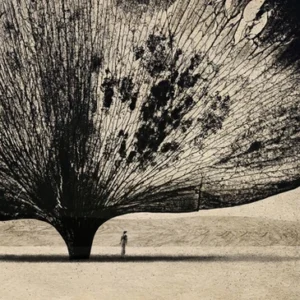
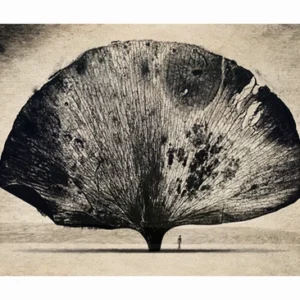
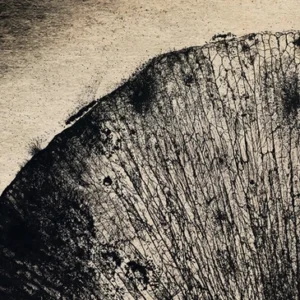
L’arbre noir, édition, 70x90cm
Can you describe the digital tools you use and how they change (or enrich) your way of seeing, your gesture, or your composition ?
The first step in my process is to scan, at high resolution, subjects such as plants, food, and so on. The scan is made directly from the actual subject, not from a photograph of it. This allows me to capture its extremely detailed structure.
Then, I set no limits on the digital tools I use, as long as they are ones I’m comfortable with. The combination of these two steps already fosters imagination : working from something real and often living, and transplanting it into a digital, that is virtual, universe.
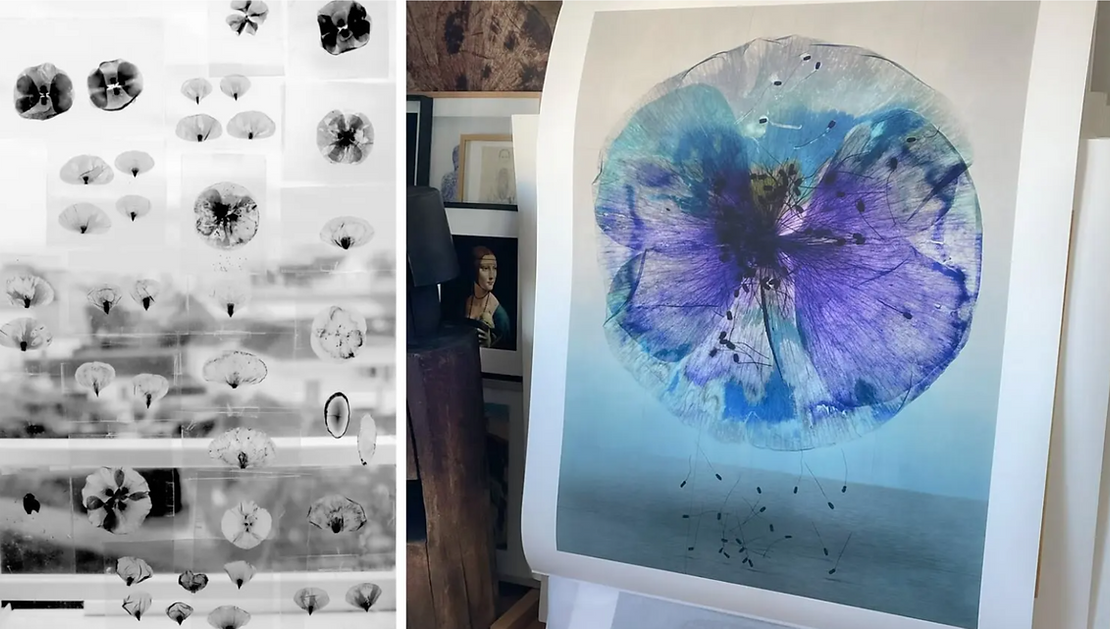
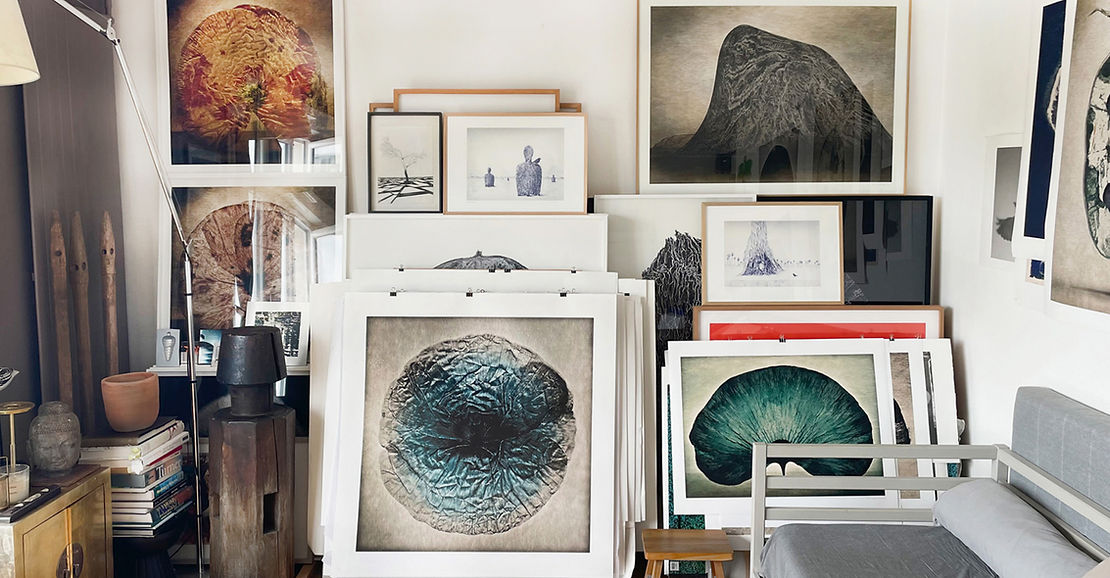
The studio
From there, it becomes an intuitive exploration through the infinite possibilities of digital tools. It’s probably this “dialogue” between different tools and this intuitive approach that allows my work to renew itself and open up to new possibilities.
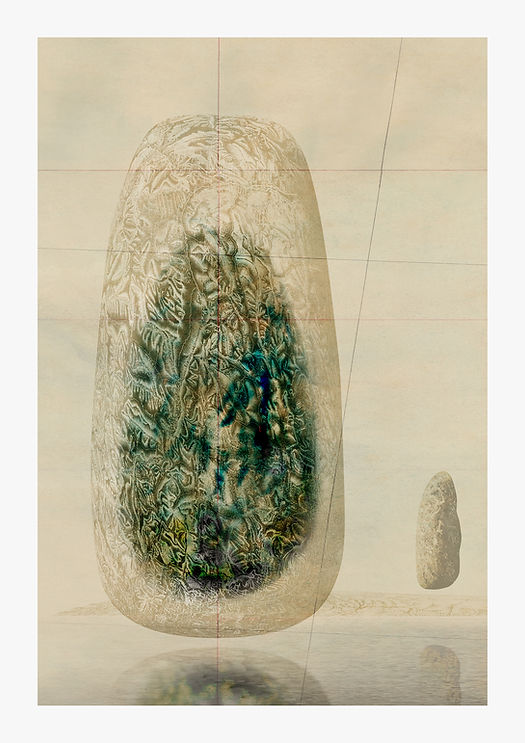
The “Élévations” series is one example : scanning 18th and 19th century topographic maps gave birth to a long ongoing series, of which the “Monoliths” are a natural continuation.
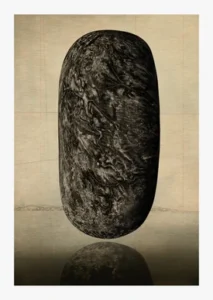
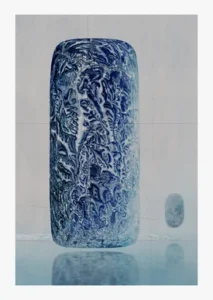
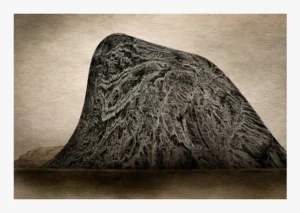
Elévation – Le Monolithe, édition, 119x84cm / Les Monolithes #4, édition, 119x84cm / Elévation – Le Puy, édition, 84x119cm
What projects are inspiring your upcoming creations ? Are there new mediums or directions you’d like to explore ?
New creations often stem from lived experiences that have deeply moved me, like “Élévations”, which I began a few years ago after hiking alone through the Cantal region. The landscape was so striking that it compelled me to explore its complexity and beauty by translating it in my own way.
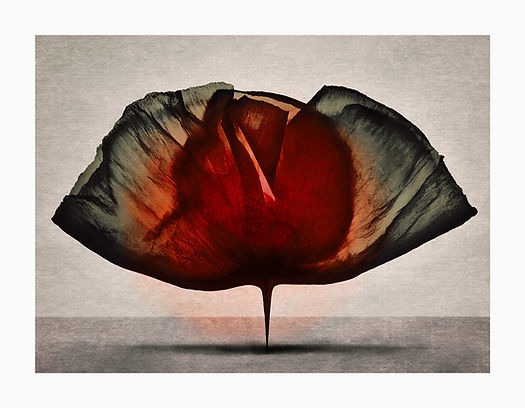
The works that evoke the poppy arise from the same emotion that returns each spring, it’s a kind of seasonal rendezvous, a creation in homage to their fleeting appearance. They are like an offering to us, one I feel obliged to reciprocate.
The projects that will inspire me next will similarly come from new emotions yet to be experienced…
What message or emotion do you hope viewers take away after seeing your work ?
Truly, I don’t have any particular message to convey through my work, it’s above all my own perception of what surrounds me, taking shape as images. I’m moved when they, in turn, evoke emotion in others.
If you could keep only one of your works, which one would you choose, and why?
That’s a question I simply can’t answer. My works surround me in my studio; each one tells its own small story, they are my daily companions.
I’d rather turn the question back to you.
“I was immediately drawn to the Monoliths series because there’s a certain mystery emanating from these works. I really like the mesmerizing effect of The Monoliths #3.” – Loïse
To discover more of Sovann Kim’s works, visit his website at http://www.sovannkim.com/ and follow his latest updates on Instagram @sovannkim.atelier